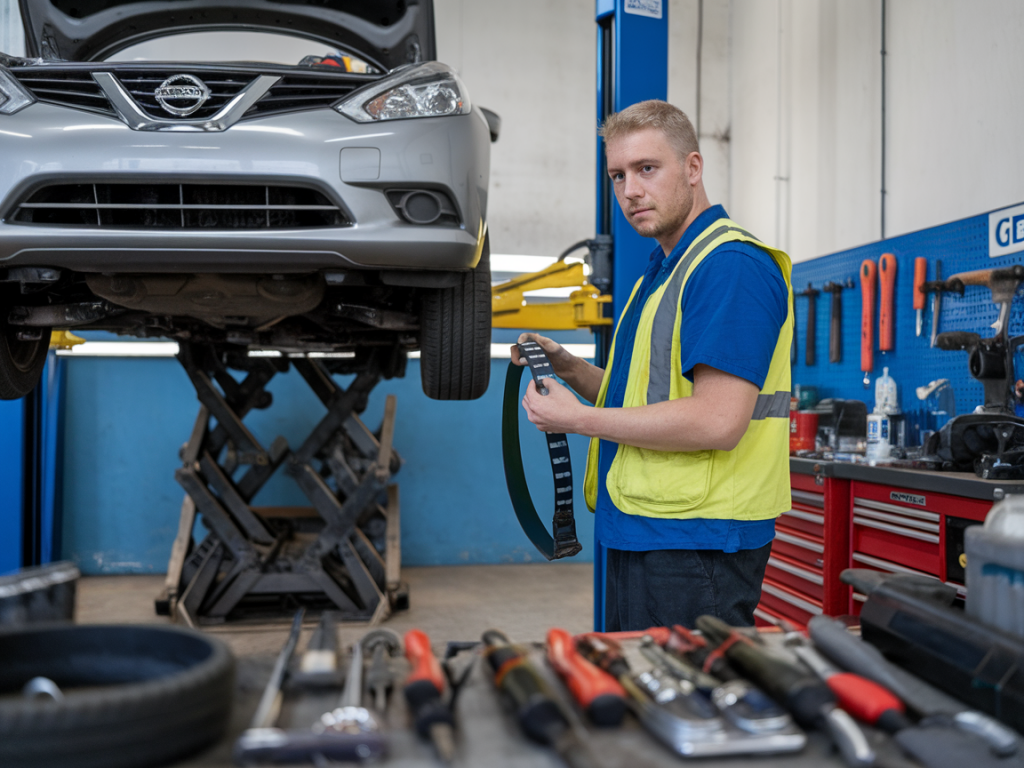
I’ve changed my share of serpentine belts on high-mileage Nissans in my own garage and at shops I’ve coordinated with. If you’re trying to pick the cheapest belt that will actually last—and then install it correctly—you’re in the right place. I’ll walk you through how I choose a belt for older Nissan engines (think KA24, SR20, QR25, VQ series and similar), what to avoid, and a step-by-step install workflow that keeps you from coming back to the parts store a week later.
Why a good belt matters on high-mileage Nissans
On older Nissans the serpentine belt drives critical systems—alternator, power steering, AC compressor and sometimes the water pump (depending on engine). When a worn belt fails, you can strand a car, overheat an engine, or lose power steering at an inconvenient time. High-mileage engines often have slightly more pulley play and worn tensioners, which raises the chance a cheap belt will slip, squeal, or shred prematurely.
How I define “cheapest durable”
“Cheapest durable” isn’t the absolute lowest price. It’s the lowest cost per reliable mile. For me that means:
Material quality: EPDM rubber belts with good tensile cords are preferred over older neoprene or unknown compounds.Fit precision: A belt that matches OEM width, rib count and profile so it tracks cleanly on the pulleys.Brand reputation or warranty: A modest warranty (1–3 years) and consistent customer reviews.Reasonable price: Not rock-bottom knockoffs—those often fail fast. Look for established aftermarket brands that undercut OEM by a modest margin.Brands I trust (good balance of price and durability)
From experience and comparison across many Nissans, these brands tend to be the sweet spot:
Gates: Common OEM supplier for many vehicles. Their Micro-V/mono-V belts are durable and widely available. Mid-priced and often the practical choice.Dayco: Comparable to Gates in quality and price—often slightly cheaper in promotions.Mitsuboshi / Bando: Japanese suppliers with good EPDM belts; sometimes better fitment on older Japanese cars.Aisin: OEM for some Nissan components—usually a touch pricier but still reasonable and reliable.Avoid no-name belts undercutting by 50%—I’ve seen them glazing over, cracking in months, or shredding under slightly misaligned pulleys.
Shopping tips to save money without sacrificing durability
Compare prices between local stores (AutoZone, O’Reilly), online retailers (RockAuto, Amazon) and manufacturer sites—sales and coupons matter.Buy during promotions or use store coupons; often a brand-name belt with a 10–20% discount is still far better value than a very cheap no-name belt.Check the belt material spec—EPDM is what you want for modern longevity.Look for belts that explicitly list the OEM part number or fitment for your exact Nissan engine and year.Consider a belt/tensioner kit if your car is high-mileage—replacing the tensioner or idler with the belt reduces risk and can be cost-effective.| Brand | Typical Price Range | Notes |
|---|
| Gates | $25–$60 | Widely available, OEM-quality; good longevity on high-mileage engines |
| Dayco | $20–$50 | Often slightly cheaper, reliable; good warranties |
| Mitsuboshi / Bando | $20–$55 | Good fit for Japanese cars; durable EPDM belts |
| Aisin | $30–$70 | OEM quality, sometimes pricier but consistent |
Inspect before you buy or install
Before buying or after removing the old belt, inspect the drivetrain:
Look for cracked ribs, glazing, oil contamination or chunking on the old belt—these indicate other problems to address.Spin pulleys by hand to check for bearing noise or play. Replace noisy idlers or a rough tensioner.Check accessory alignment—misaligned pulleys ruin belts quickly.If the belt shows oil contamination, find the leak (valve cover gasket, crank seal) before installing a new belt.Basic tools and parts I keep on hand
For most Nissan serpentine belt jobs:
Socket set and ratchet (10mm–19mm commonly)Belt tensioner tool or breaker bar (long-handled 3/8 or 1/2” depending on the tensioner bolt)Screwdrivers and pry bar (gentle leverage)Torque wrench for reassembly (consult service manual)Replacement belt and optionally a tensioner/idler kitStep-by-step installation (general approach I use)
Note: belt routing and tensioner bolts vary by engine—always have a picture of the belt routing or the diagram usually found under the hood. Consult your service manual for torque specs.
Park on level ground, set the parking brake, disconnect the negative battery terminal if you’ll be working near electrical components.Compare the new belt to the old: same rib count, width and length. Lay both flat—ribs should match profile exactly.Take a photo of the belt routing if there’s no diagram; some Nissans have tricky routing around idlers.Locate the tensioner. Use the appropriate wrench or tensioner tool to rotate it and relieve tension on the belt. Move slowly—tensioners can snap back if released abruptly.Remove the belt off the pulleys. Don’t pry hard on pulleys; gently ease the belt off.While the belt is off, spin each pulley by hand. If you feel roughness, replace that pulley or the tensioner.Route the new belt around the pulleys following the diagram/photo. Leave the tensioner pulley for last.Rotate the tensioner to create slack and slip the belt over the tensioner pulley. Slowly release the tensioner so it takes up the belt tension.Inspect belt seating—each rib should sit flush in the pulley grooves. Look for any ribs riding on pulley flanges which signals wrong size or misalignment.Start the engine briefly (after reconnecting battery) and listen—no squeal, no slapping, smooth idle. Turn off and recheck belt seating after a short run.Check drive belt tension if adjustable tensioner—refer to spec. Most modern Nissans have automatic tensioners and you don’t measure static tension; instead verify smooth operation and no slipping.Common pitfalls and how I avoid them
Reusing a worn tensioner: If it’s noisy or the pulley wobbles, replace it. The few dollars you spend can save a few hours and a second trip.Buying by price only: I’ve learned the hard way that the cheapest belt can cost you more if it fails early.Ignoring oil contamination: If oil reached the belt, it’ll eat a new belt fast. Fix the leak first.Incorrect routing: Always verify routing diagram—getting one rib off can cause premature wear or failure.When to replace more than the belt
If your Nissan is high-mileage (over 100k), I often replace at least the tensioner or any idler that shows wear at the same time. A belt/tensioner kit can be a low incremental cost and prevents early repeat failures—worth it in my book.
If you want, tell me your Nissan model, engine code and mileage and I’ll recommend a specific belt part number and whether I’d swap the tensioner too. I can also walk you through tensioner-specific tricks for certain Nissan engines if you plan to do the work yourself.