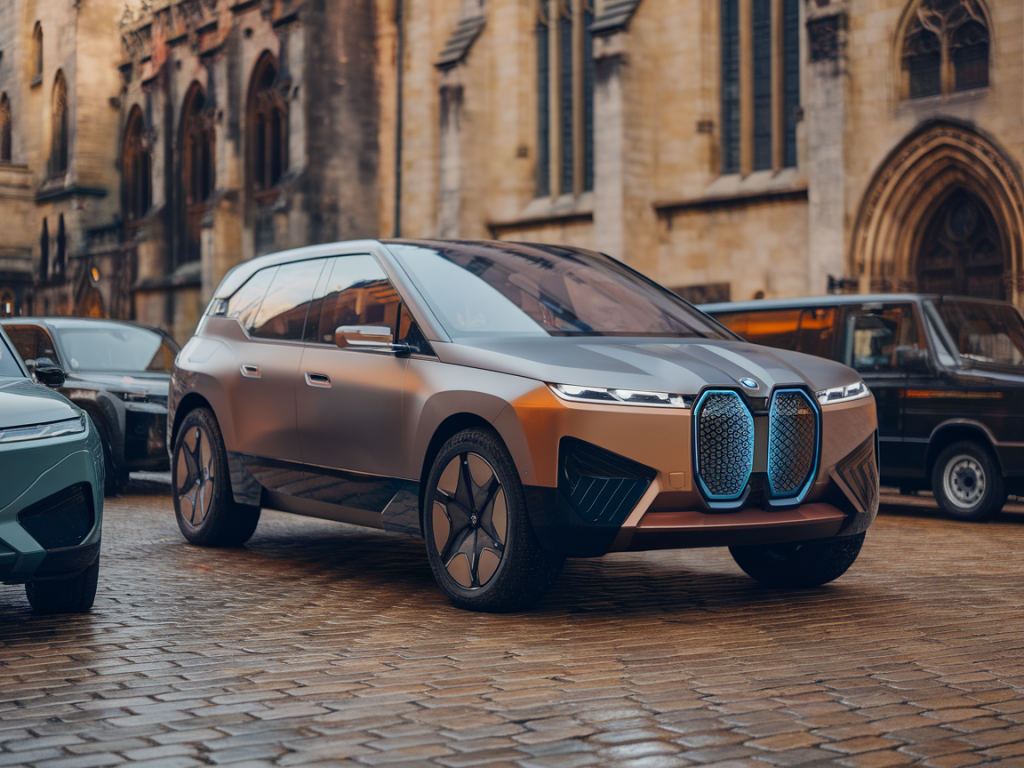
I’ve been following electrification trends for years, and the latest announcement that BMW will bring an 800-volt architecture to a compact Neue‑Klasse SUV in 2027 has me thinking about more than just charging times. The phrase futur SUV électrique BMW architecture 800 volts is more than a headline — it’s a signal about where hardware, energy strategy and even the fate of combustion might be heading.
Why 800 volts? The technical case I find convincing
When manufacturers talk about an 800-volt electrical architecture, they’re addressing a set of physical constraints that have governed EV design for a decade. Higher system voltage means the same power can be delivered with lower current, which reduces heat in wiring and allows for thinner, lighter cables. That in turn simplifies thermal management and permits much faster DC fast-charging rates.
- Faster charging: 800V systems can accept higher power — often in the 200–350 kW range — more efficiently. Porsche and Hyundai/Kia have already demonstrated this with Taycan and E‑GMP cars.
- Better thermal behavior: Lower current reduces resistive losses (I²R), which helps maintain battery temperature during high-power charging or heavy driving.
- Smaller components: Inverters, wiring harnesses and cooling systems can be optimized for size and weight.
Those advantages are why I believe BMW’s decision to apply 800V to a compact Neue‑Klasse SUV matters: it brings high-end charging and efficiency to a mass-market segment.
How an 800V BMW SUV will differ from today’s EVs — my practical read
From the real-world perspective I care about (ownership costs, reliability, charging behavior), an 800V platform changes several dimensions:
- Charging time expectations: A 10–80% charge can fall significantly under 20–25 minutes on a 350 kW charger, depending on battery chemistry.
- Useable range stability: Because thermal control is easier, sustained high-speed runs or repeated fast charges should degrade range less than with a 400V counterpart.
- Repair and service considerations: High-voltage components require specialized training and tooling. I expect dealer networks will need investment — a factor for independent workshops and owners who like DIY.
Comparing 400V vs 800V: numbers that matter
I like to see figures when assessing change. The table below summarizes typical characteristics I reference when comparing architectures.
| 400V systems (typical) | 800V systems (typical) | |
|---|---|---|
| Peak DC charging power | 100–250 kW | 200–350+ kW |
| Charging current for same power | Higher (double roughly) | Lower (≈ half) |
| Typical real-world 10–80% charge time | 25–45 min (varies) | 15–30 min (varies) |
| Component size (inverter, cabling) | Larger, thicker cabling | Smaller, lighter cabling |
| Examples | Tesla Model 3/Model Y (earlier), many EVs | Porsche Taycan, Hyundai/Kia E‑GMP, upcoming BMW Neue‑Klasse |
What BMW’s move tells me about strategy and timing
BMW placing an 800V architecture into a small Neue‑Klasse SUV — reportedly the iX1 Neue‑Klasse arriving in 2027 — signals a few strategic intentions:
- Democratization of high-performance EV tech: 800V is no longer limited to premium halo models. That matches consumer demand for shorter charge stops and better thermal resilience.
- Platform scalability: Neue‑Klasse is designed as a flexible architecture. Introducing 800V at the compact end shows BMW expects the supply chain and charging ecosystem to be ready.
- Competitive parity: Rivals (VW Group, Mercedes, Hyundai-Kia) have already invested; BMW adopting 800V is about keeping product competitiveness.
I find that such a move is less about one car and more about future-proofing a family of vehicles and electrified services (charging partnerships, software updates, etc.).
Will combustion engines survive? My take on the long arc
The question "combustion survive?" is often shorthand for "will internal combustion engine (ICE) vehicles remain relevant or disappear quickly?" From where I sit, the answer isn’t binary — it’s sector-specific and region-dependent.
- Market share trends: In Europe, plug-in and battery EV sales share rose from about 10% in 2019 to over 25% by 2023 in some markets; projections suggest accelerated adoption, but full replacement will take time. (See EU and industry reports linked below.)
- Segment resilience: Niche uses (heavy-duty, long-haul trucking, classic cars, some industrial uses) will keep combustion around longer unless hydrogen or synthetic fuels scale rapidly.
- Policy and infrastructure: Regions with strict emissions targets and fast charging rollouts will see a faster ICE decline. Where charging infrastructure lags, ICE will persist.
For me, BMW’s 800V SUV doesn’t spell the immediate death of combustion. Instead, it accelerates EV adoption in mainstream segments — the most likely scenario is coexistence for the next decade followed by faster ICE attrition in the 2030s.
Ownership realities I’m watching closely
As someone who writes for owners, there are a few practical aspects I want clarity on when the 800V iX1 lands:
- Charging network compatibility: Will public chargers widely support true 350 kW sessions, or will owners mostly see 150–200 kW limits? In many countries, 150 kW is still more common.
- Battery longevity: How will repeated high-power charging affect battery degradation? Modern cell chemistries and active thermal management can mitigate harm, but long-term data is scarce.
- Service costs and safety: High-voltage systems carry repair and diagnostic premiums. I expect dealer service rates to reflect that; independent shops may take longer to adopt necessary tools and training.
Pros and cons I weigh when recommending an 800V vehicle
- Pros: Faster charging, improved efficiency at high loads, potentially lighter components, better performance under stress.
- Cons: Scarcer ultra-high-power chargers today, potentially higher servicing costs, greater dependency on battery supply chains and advanced cooling systems.
Sources and further reading I rely on
I cross-check industry announcements, tests and regulatory data. For this topic I recommend:
- Terra Auto — BMW reveals the date of the iX1 Neue‑Klasse (French) (context and launch timing)
- BMW Group official news (corporate releases and technical briefs)
- Autocar — coverage on Neue‑Klasse and architectures
- Electrek — explainer on 800V systems
Key stats I think help readers decide
- Target launch: 2027 for the compact Neue‑Klasse SUV with 800V (reported).
- Expected charge power: 200–350 kW class on compatible CCS DC chargers.
- Charging advantage: potential 10–80% sessions under 20 minutes on ideal chargers.
- Industry context: Several major OEM platforms are shifting to 800V for performance and efficiency gains.
FAQ — questions I get asked most often
- Will an 800V BMW charge faster at my local station? Only if the station and cable support higher power. Many public chargers are still 150 kW; ultra-fast 300+ kW units are growing but not ubiquitous.
- Is battery degradation worse with 800V fast charging? Not necessarily. The combination of cell chemistry and active thermal control determines degradation more than system voltage alone.
- Will maintenance be more expensive? Likely, at least initially: high-voltage training, parts and diagnostics raise service costs compared with legacy ICE cars.