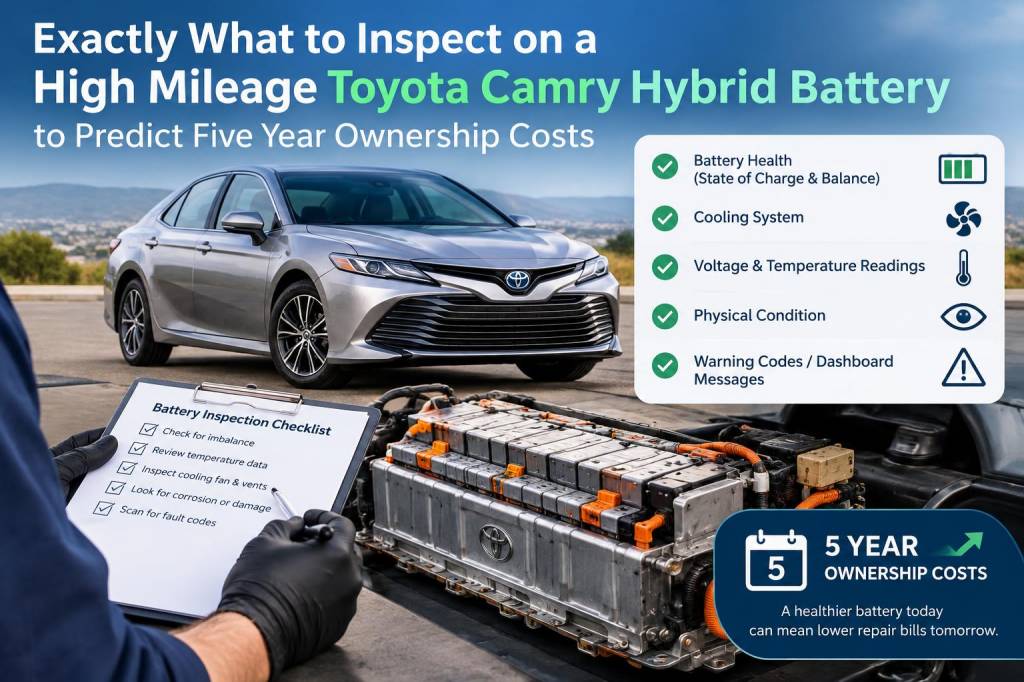
I’ve spent a lot of time under the hoods of high-mileage Toyotas, and hybrids like the Camry bring a mix of reassurance and special checks. On paper, Camry hybrids are durable: the electric assist reduces strain on the gasoline engine, and Toyota’s hybrid architecture is proven. In reality, predicting five-year ownership costs for a Camry with high miles comes down to one component above all: the hybrid battery and the systems that support it.
Why the hybrid battery matters for ownership cost
The hybrid battery is both expensive and decisive. If it’s healthy, you’ll enjoy excellent fuel economy and low repair bills. If it’s failing, repair or replacement can be your largest single unexpected cost. I treat the hybrid battery the way I treat a used car’s transmission: the component most likely to move the ownership-cost needle.
Types of Camry hybrid batteries and what to expect
Toyota used two main chemistries in Camry hybrids over the years: nickel-metal hydride (NiMH) for many common model years, and lithium-ion (Li-ion) in select trims and later years. Both can last well past 200,000 miles if cared for, but they age differently. NiMH tends to degrade more gradually; Li-ion can show a sharper capacity drop if individual modules fail.
What I always inspect first — a practical checklist
- Charging and DTCs (diagnostic trouble codes): Hook the car to an OBD-II scanner that can read hybrid-specific codes (Toyota Techstream is ideal; consumer tools like BlueDriver or Torque Pro plus the right plugin can catch basic codes). Look for codes on battery pack voltage imbalance, inverter issues, or high voltage battery cooling faults.
- State of Charge (SoC) and voltage readings: Using Techstream or a hybrid-capable Bluetooth module, check module voltages and pack voltage under different loads. Large variation between modules (>0.3–0.5 V on NiMH modules, lower on Li-ion) signals imbalance or failing modules.
- Battery cooling system: Many Camry hybrids have an air or liquid cooling path and a fan; clogged ducts, failed fans, or leaking coolant (if equipped) accelerate battery wear. Inspect for debris, sand, rodent nests, or corrosion around the cooling components.
- Visual inspection of the pack: Listen and look for obvious signs — corrosion on terminals, water intrusion, dents, or previous repair evidence. While you shouldn’t dismantle the pack without training, an external check tells you if the pack has been treated roughly.
- Hybrid ECU/inverter condition: Inverter failures are less common than pack failures but can be expensive. Check for water damage, coolant leaks (if inverter is liquid-cooled), and history of overheating codes.
- Charging behavior and fuel economy: Drive the car on mixed routes. Notice whether the battery provides expected assist and regen. Steep drops in MPG or early transition to the gasoline engine under light loads can indicate reduced battery capacity.
- Service history and warranty: Ask for records showing hybrid battery checks, coolant service, inverter repairs, or battery modules replaced. Toyota’s original warranties vary by market and model year — a remainder of warranty is a huge value.
Specific measurements I request or perform
- Pack voltage at idle and during discharge/regen (compare to service manual specs).
- Individual module voltages (for NiMH usually grouped; for Li-ion more granular).
- Battery pack internal resistance / conductance test — many shops use a battery analyzer to estimate state of health (SoH).
- Coolant flow and fan RPM (where applicable).
Interpreting what you find
It’s tempting to take a single number and declare doom, but context matters. A modest voltage spread and slightly reduced SoH might mean 10–15% fuel economy loss and no imminent failure. Large imbalance, frequent hybrid system faults, or failing cooling components predict short-term, likely-expensive repairs.
Cost scenarios for the next five years
To make realistic predictions, I separate likely outcomes. Below I use rough U.S. market pricing as a baseline — your region will vary. Labor rates, access to remanufactured packs, and local parts availability change the math.
| Scenario | Signs | Estimated 5-year cost range (parts + labor) | Notes |
|---|---|---|---|
| Low risk | No DTCs, small voltage spread, good cooling | $0–$1,000 | Routine service (cooling, software updates). No pack work likely. |
| Moderate risk | Minor imbalance, reduced SoH, occasional efficiency loss | $1,000–$3,000 | Module-level repairs or remanufactured pack from reputable vendor; possible inverter inspection. |
| High risk | Multiple DTCs, large voltage variance, cooling failure | $3,000–$8,000+ | Full pack replacement or high labor inverter repairs; OEM pack + dealer labor pushes upper end. |
Real-world pricing and repair options
Here’s what I’ve seen in the field:
- OEM remanufactured pack from Toyota: Most expensive; depending on model year and region, $4,000–$8,000 installed. Excellent reliability and warranty.
- Third-party remanufactured pack: $2,000–$4,000 installed. Quality varies — pick known shops with module-level testing and warranty (e.g., local hybrid specialists or nationwide services).
- Module replacement / hybrid shop reconditioning: $1,000–$2,500. Good if failures are isolated to a few modules and the shop does proper balancing and testing.
- Used/salvage packs: $800–$2,000. Riskier but cost-effective if vendor provides a short warranty and recent testing results.
How I estimate a five-year budget step-by-step
- Start with the current SoH and diagnostic picture. If SoH >85% and no faults, budget minimal ($500–$1,000) for coolant/fan service and an allowance for unexpected items.
- If SoH 70–85% with imbalance, budget a mid-range repair ($1,500–$3,000): this buys a reman pack or module-level rebuild.
- If SoH <70% or persistent hybrid-system faults, plan for the high end ($3,000–$8,000), especially if you want OEM-level reliability.
- Always add a 10–20% contingency for labor, inverter or cooling-system repairs, and inflation.
Negotiation and buying tips
If you’re buying a high-mileage Camry hybrid:- Ask for a Techstream log or a recent hybrid battery health printout before making an offer.- Factor potential battery costs into your offer — sellers often overprice cars without disclosing hybrid faults.- Prefer cars with service records for battery cooling maintenance and inverter repairs. That evidence reduces risk.
My practical quick tests you can do on a test drive
- Watch the dash during acceleration and deceleration: sudden loss of EV assist or repeated “check hybrid system” messages are red flags.
- Note MPG over a mixed-route drive — if the car consistently underperforms by more than 10–15% relative to EPA estimates for the model and year, investigate the pack.
- Listen for abnormal sounds from the trunk area (where many packs are located) or the inverter area: fans running constantly or grinding noises point to cooling issues.
Predicting five-year ownership costs for a high-mileage Camry hybrid is about making an informed gamble: the better you inspect the battery system and its supporting hardware, the smaller the gamble becomes. I always prioritize a clear diagnostic snapshot up front — it’s the difference between a long, worry-free ownership run and a surprise that hits your wallet hard.