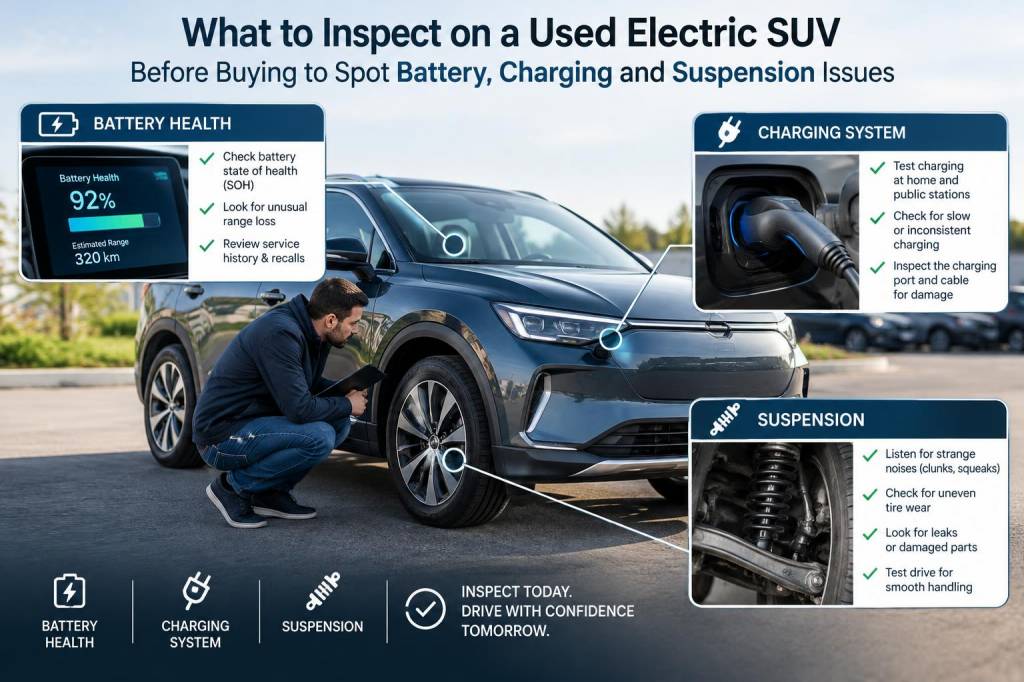
When I look at a used electric SUV, I try to think like a skeptical owner, not a hopeful shopper. A polished exterior and a quiet test drive can hide expensive problems, especially in an EV where battery health, charging behavior, and suspension wear matter far more than many buyers expect. I have seen people fall in love with the instant torque and low running costs, only to discover that a weak charging system, a degraded pack, or a tired suspension turns a “great deal” into a costly repair project.
My approach is simple: I inspect the vehicle as if I may need to live with it for years, not days. That means checking evidence of battery wear, confirming that charging works in real conditions, and paying close attention to underbody and suspension condition. A used electric SUV can be a smart purchase, but only if I verify the parts that are hardest to see and most expensive to fix.
Start with battery history, not just mileage
With an electric SUV, mileage alone does not tell me much. A vehicle with moderate mileage can still have a tired battery if it has spent years fast-charging in hot weather or sitting at a very high state of charge for long periods. I always ask for service records, battery warranty information, and any available state-of-health report from the seller or dealer.
If the seller cannot provide battery-related records, I become cautious. I want to know whether the vehicle has had software updates, battery checks, or any previous repairs related to the high-voltage system. Some brands make this easier than others, but even when records are thin, there are still clues I can use.
- Ask whether the battery has ever been replaced, repaired, or reconditioned.
- Check whether the vehicle still carries an active battery warranty.
- Request charging history if available through connected-car data or a dealer report.
- Look for signs of poor ownership, such as repeated warning lights or neglected maintenance.
Look for real-world signs of battery degradation
I do not rely on a sales pitch about “good range for its age.” I want to see what range the SUV actually delivers in normal use. If possible, I arrive with the battery fully charged or ask the seller to have it charged before I get there. Then I compare the displayed range with what similar examples of the same model usually show.
A meaningful drop in range is not always a deal breaker, but it should be explained. A battery that has lost a noticeable amount of capacity may still work fine for city use, yet it can become frustrating on long trips. I also watch for uneven range behavior. If the remaining range drops too quickly, or if the vehicle seems to estimate range erratically, that can point to battery management issues or weak cells.
During the test drive, I pay attention to:
- How quickly the battery percentage falls under steady driving.
- Whether range estimates improve or worsen dramatically after a reset or software update.
- Whether the car feels limited in power when the battery is not close to full.
- Any warning messages related to the high-voltage system.
I also check whether the cooling system seems to work properly. Battery temperature management matters a lot, especially in larger SUVs that may be used for towing, family travel, or repeated fast charging. If the battery gets hot easily, charging may slow down, and long-term wear can increase.
Inspect charging ports, cables, and charge behavior
Charging problems are one of the easiest ways to turn a practical EV into a headache. I always inspect the charge port closely. I look for bent pins, corrosion, loose connectors, damaged seals, and evidence that the port cover has not been closing properly. A broken port door may seem minor, but it can allow moisture and dirt into a sensitive area.
I also test charging from more than one source if possible. I want to know whether the SUV accepts normal AC charging without interruption and whether it can communicate properly with a DC fast charger. Some issues only appear under load, especially if the car has software faults, port damage, or problems with onboard charging hardware.
Here is what I want to confirm during a charging check:
- The vehicle starts charging immediately and consistently.
- Charging speed is reasonable for that model and battery size.
- No warning lights appear during plug-in or unplug.
- The cable releases normally after charging ends.
- The charging session does not stop unexpectedly.
If I can, I check whether the vehicle has ever suffered from repeated charging errors. A seller may describe that as a “small glitch,” but in my experience repeated charging interruptions can indicate deeper issues with the port, the battery management system, or internal charging electronics. Those repairs are rarely cheap.
Do not ignore the underbody and battery protection
Many electric SUVs have a heavy battery pack mounted low in the chassis, which can be good for balance but vulnerable to impact. I always look under the vehicle for scrape marks, dents, rust, or evidence of ground contact. A battery case should not show signs of abuse. Deep gouges, fresh impact marks, or deformation around the pack area make me pause immediately.
I also inspect the plastic shields and underbody panels. If those pieces are cracked or missing, I want to know why. They protect wiring, connectors, and cooling lines. A rough life on poor roads, repeated curb strikes, or off-road use can damage more than people realize.
Rust matters too, even on a modern EV. Suspension mounting points, brake components, subframes, and fasteners can corrode just like on any other SUV. If the vehicle lives in a wet or salty climate, I spend extra time checking wheel arches, lower control arms, and the rear suspension area.
Pay close attention to suspension wear
This is where I often find hidden neglect. Electric SUVs are heavy, and that extra weight can accelerate wear on springs, bushings, shocks, and control arms. A vehicle may feel fine for the first few minutes of a drive, then reveal clunks, wandering steering, or a harsh ride once I hit rough pavement.
I check for uneven ride height first. If one corner sits lower than the others, I suspect worn components, air suspension trouble, or previous damage. On models with adaptive or air suspension, I listen for compressor noise, slow height changes, or warning messages. Those systems can be wonderful when working properly, but expensive when they fail.
During the test drive, I listen and feel for:
- Clunks over bumps or driveway entrances.
- Rattles from the front end or rear cargo area.
- Excessive bouncing after dips or speed humps.
- Steering that feels loose, vague, or uneven.
- Pulling to one side during braking or cruising.
I also check tire wear carefully. Uneven inside-edge wear can point to alignment problems or worn suspension parts. On a heavy EV, tires tell a very honest story. If the tires are worn oddly, I assume the suspension may need attention even if the seller claims everything is fine.
Use a test drive that reveals problems, not just comfort
I never judge a used electric SUV by a short, gentle loop around quiet streets. I want a route that includes rough pavement, stops, faster roads, and a few tight turns. That gives me a better sense of steering precision, brake feel, regenerative braking behavior, and body control.
In an EV, regenerative braking can hide some brake issues because the friction brakes are used less often. I still want to know whether the pedal feels consistent and whether the SUV stops straight. Surface rust on brake rotors is common, but a shaking pedal, grinding noise, or uneven stopping performance deserves attention.
I also test acceleration from low speed and from highway pace. A weak battery or restricted power output may show up only under stronger demand. If the car feels unusually sluggish, I ask whether that is normal for the model or whether the battery has entered a protection mode.
What I ask the seller before I make an offer
When I am seriously considering a used electric SUV, I ask direct questions and I listen carefully to the answers. A confident, informed seller usually gives specific details. A vague seller often leaves me with more caution than confidence.
| Question | What I want to hear | What worries me |
|---|---|---|
| How often was it fast-charged? | Regular use, but not excessive abuse | Daily fast charging with no explanation |
| Has battery health been checked? | A documented state-of-health report | No data, no records, no interest |
| Any charging faults? | Clear history with no repeat issues | Repeated errors or intermittent failures |
| Any suspension repairs? | Routine service or normal wear items | Air suspension faults, clunks, or repeated alignments |
| Has it been in an accident? | Full disclosure with repair invoices | Missing details or inconsistent answers |
Check software, warnings, and hidden electronic faults
Electric SUVs depend heavily on software, so I treat warning lights and strange display behavior seriously. A screen that freezes, resets, or shows inconsistent battery data can indicate more than an inconvenience. I look through every menu I can access and make sure there are no fault codes, warning icons, or disabled features.
If the vehicle has an app or online account history, I try to confirm whether charging sessions, service reminders, or remote features have worked properly. Some problems only appear when the car is connected to the wider system. I also check driver-assistance features, climate control, parking sensors, and all-electric accessories, because electrical faults often travel in groups rather than as isolated problems.
My personal red flags on a used electric SUV
There are a few things that make me walk away faster than anything else. I do not need a perfect vehicle, but I do need a transparent one. If I see evidence of impact near the battery pack, repeated charging failure, serious uneven tire wear, or suspension noises combined with vague seller answers, I stop treating it as a bargain.
- Battery range that is far below expectations with no clear reason.
- Charging port damage or repeated charging interruptions.
- Underbody impact marks near the battery enclosure.
- Suspension clunks, sagging ride height, or air suspension warnings.
- Inconsistent service history or missing repair documentation.
- Warning lights that appear and disappear without explanation.
When a used electric SUV passes these checks, I feel much more confident that I am looking at a vehicle worth serious consideration. I still budget for tires, alignment, brakes, and software updates, because EV ownership is never completely maintenance-free. But if the battery health is solid, the charging system behaves properly, and the suspension feels tight, the car has already cleared the biggest hurdles in my mind.