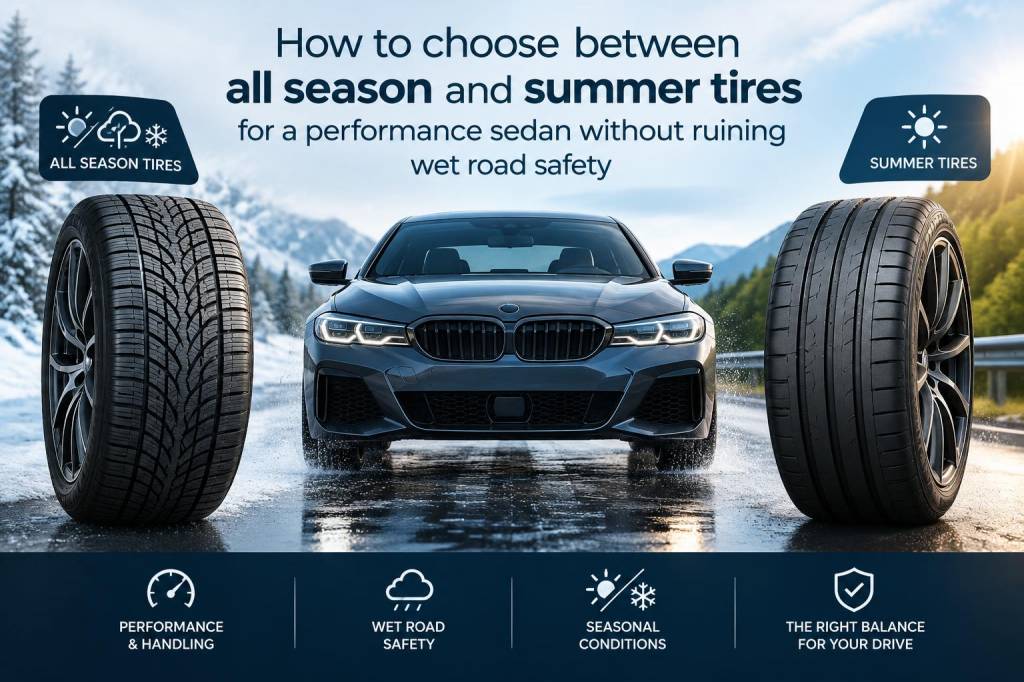
I have spent enough time around performance sedans to know that tire choice is rarely as simple as a label on the sidewall. When I am helping someone choose between all-season and summer tires, I do not start with lap times. I start with the way they actually drive: morning commutes in cold rain, weekend back-road runs, highway trips, and the occasional hard stop when traffic turns messy. For a performance sedan, that mix matters because a tire that feels brilliant on dry pavement can become frustrating, or even unsafe, once water enters the picture.
I also think a lot of drivers ask the wrong question. They ask, “Which tire is better?” I ask, “Which tire is better for your roads, your climate, and your tolerance for compromise?” A performance sedan makes that choice more interesting because chassis balance, steering precision, brake feel, and traction control all depend on how well the tire works in real conditions. If I choose too much dry grip and ignore rain performance, I may end up with a car that feels exciting for three months and annoying for nine.
What I look at before anything else
My first filter is weather, not power. If I live somewhere with hot summers, frequent thunderstorms, and mild winters, I can justify a summer tire more easily than someone dealing with long cool seasons and unpredictable rain. If temperatures often sit near or below 45°F, I become cautious about summer tires because they lose flexibility as the rubber hardens. That affects grip, braking distance, and confidence in wet conditions.
Then I look at mileage and driving style. If I drive aggressively, enjoy sharp turn-in, and want the steering to feel alive, summer tires usually make more sense. If I cover many highway miles, spend plenty of time in cold rain, and want one tire to handle a broad range of conditions, an all-season tire becomes more attractive. For a performance sedan, I have learned not to dismiss all-season tires as “comfort choices.” Modern ultra-high-performance all-season models can be genuinely capable, especially in wet weather.
The final filter is storage and convenience. A summer-and-winter tire swap is ideal in some cases, but if I do not want a second set of wheels, do not have storage space, or simply do not want seasonal changeovers, that reality matters. A tire choice has to fit my life, not just my enthusiasm.
What summer tires do well
Summer tires exist for one main reason: they are built for maximum grip in warm conditions. On a performance sedan, that means better cornering response, stronger dry braking, and more precise steering. When I push a good summer tire on a warm road, the car feels more connected. The sidewalls are usually stiffer, and the tread compound is designed to work at higher temperatures. That gives me confidence during fast lane changes, spirited mountain driving, and hard acceleration out of corners.
In wet weather, summer tires can still perform well, but only up to a point. A quality summer tire with deep enough tread and good water evacuation can be excellent in rain during warm months. The problem is not that every summer tire is unsafe in water. The problem is that their wet performance can drop more sharply as tread wears, temperatures fall, or standing water becomes deeper. Once conditions get cool, the compound can lose the edge that made it impressive in the first place.
I have also noticed that some drivers overestimate wet grip because a summer tire feels stable at modest speeds. Straight-line traction may seem fine, but emergency braking and cornering in heavy rain are where weaknesses show up. If I plan to drive through frequent storms, I do not rely on brand reputation alone. I want clear wet-braking data, not just a good subjective feel.
What all-season tires do well
All-season tires are about balance. For a performance sedan, that balance can be surprisingly good. A modern ultra-high-performance all-season tire can offer strong wet traction, reasonable dry grip, and better cold-weather tolerance than a summer tire. If I live in a place where rain is common and temperatures swing a lot, this matters more than absolute dry grip.
What I appreciate most about a strong all-season tire is consistency. It may not feel as razor-sharp as a summer tire on a hot dry road, but it often gives me a wider operating window. That means I can leave it on the car longer through the year and feel more relaxed when weather shifts. For many drivers, that consistency is worth more than a small reduction in cornering grip.
Still, I do not pretend all-season tires are equal. A cheap touring all-season tire and a performance-oriented all-season tire are very different products. If I am choosing for a sedan with real power and sharp handling, I want a tire designed for that mission. I would rather spend more on a genuinely capable performance all-season than save money and accept dull steering plus mediocre wet braking.
Wet-road safety is where I make my decision
If wet-road safety is my priority, I stop thinking only about grip and start thinking about water evacuation, tread depth, compound temperature range, and braking consistency. Rain changes everything. A tire that feels brilliant in warm dry weather can lose traction suddenly if it cannot move water away from the contact patch fast enough.
For me, wet safety depends on three things:
- Hydroplaning resistance, which depends on tread design and remaining tread depth
- Cold-wet grip, which matters when rain arrives during cooler mornings or shoulder seasons
- Braking stability, because confident steering is meaningless if stopping distances grow too much
This is where all-season tires often earn my respect. If I expect heavy rain, cooler temperatures, and variable conditions, a performance all-season tire can give me a more forgiving margin. That margin matters when roads are polished, puddles are deep, or the temperature drops after sunset. I would rather have slightly less dry performance and more confidence in bad weather than the reverse.
That said, not every summer tire is a poor wet-weather tire. Some premium models do a very good job in rain, especially when new. The catch is that their wet advantage can be narrower than people think, and their behavior can decline faster as temperatures fall. If I am honest with myself, a summer tire is usually a specialist choice, while an all-season tire is the safer all-rounder.
What I ask from a performance sedan owner
When someone tells me they drive a performance sedan, I want to know how they actually use it. A car like a BMW 3 Series, Audi S4, Mercedes-AMG C-Class, Genesis G70, Cadillac CT4-V, or Tesla Model 3 Performance can wear either tire type depending on priorities. The badge does not decide for me; usage does.
If the car is a weekend machine, stored in winter, and driven hard on dry roads, I lean toward summer tires. If the car is a year-round commuter with strong horsepower and frequent rain exposure, I lean toward a performance all-season. If the driver wants a single set of wheels for convenience, I lean even more toward a high-quality all-season. If they are willing to change wheels seasonally, I may suggest summer tires for warm months and a winter set when conditions demand it.
I also ask whether the driver values steering feel more than ride comfort. Summer tires usually sharpen steering but can transmit more road texture. All-season tires often soften that edge a little. On a performance sedan, that tradeoff can be noticeable. I have driven setups where the summer tire made the car feel electric, and others where the all-season made the car calmer without making it boring. That balance is not always a compromise; sometimes it is the smarter match.
What I check on a tire label and in real testing data
I never choose based on category alone. I look at load rating, speed rating, UTQG wear figures, and independent test results when I can find them. I pay special attention to wet braking, wet cornering, and hydroplaning tests, because those reveal much more about real-world safety than marketing language.
| Factor | Summer Tire | Performance All-Season |
|---|---|---|
| Dry grip | Usually stronger | Very good, but often lower |
| Wet grip in warm weather | Good to excellent | Good to very good |
| Wet grip in cool weather | Can drop noticeably | Usually more consistent |
| Cold-weather tolerance | Poor to limited | Better |
| Steering sharpness | Usually sharper | Usually softer |
| Convenience | Lower if seasonal swap is needed | Higher for year-round use |
I do not treat tables like final answers, but they help me separate emotion from evidence. A tire that wins on a racetrack can still be wrong for a driver who faces rain, traffic, and temperature swings. A practical choice starts with measurable safety, then moves to feel.
My rule for avoiding regret
If I had to reduce my thinking to one simple rule, it would be this: choose summer tires only if your climate and driving habits let you enjoy them often enough to justify their limits. If you are going to spend a lot of time in rain, shoulder-season chill, or mixed conditions, a performance all-season tire is usually the safer and more sensible answer.
I am also careful not to ignore tread life and replacement timing. A worn summer tire can become a much weaker wet-weather tire long before it looks “done” to the eye. If I run summer tires, I monitor tread depth closely and replace them before they become sketchy in standing water. If I run performance all-seasons, I still watch tread because wet safety depends heavily on it, but I know the tire started with a wider safety window.
In practical terms, I would rather choose a tire that keeps me calm in a sudden rainstorm than one that feels heroic on one perfect dry afternoon. A performance sedan should feel rewarding, but it should also feel trustworthy. For me, that trust comes from matching the tire to the weather I actually face, not the weather I imagine.
When I shop for a new set, I read wet-test results, check local temperature patterns, and ask myself whether I want maximum dry response or broader safety margin. That one question usually points me toward the right side of the decision.