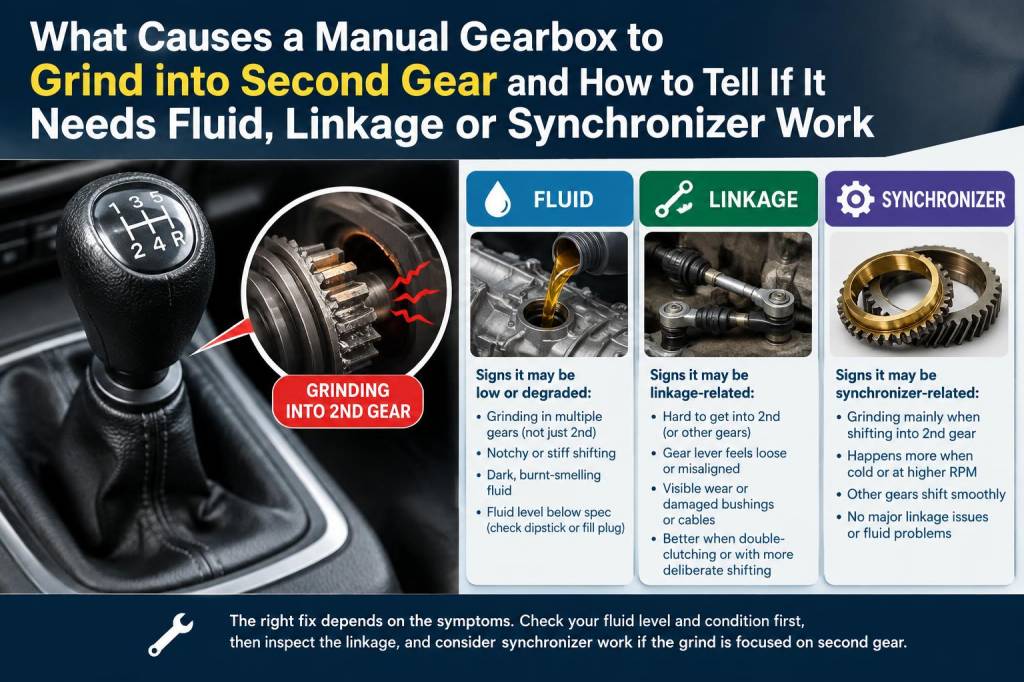
When a manual gearbox grinds into second gear, I always treat it as a warning, not a quirk. A clean shift should feel deliberate and smooth, even when the car is cold or the driver is moving quickly. If second gear pushes back with a crunch, a scrape, or a moment of resistance before it engages, I start thinking about a small set of likely causes: low or degraded fluid, a linkage or cable problem, clutch drag, or wear inside the synchronizer for second gear.
What makes second gear so important is that it is often used constantly in real driving. It sees repeated use in city traffic, in slow corners, during downshifts, and during brisk acceleration. Because of that, any weakness in the shift system usually shows up there before it becomes obvious in other gears. I have seen people assume a grinding second gear means a whole transmission is failing, but in many cases the issue is narrower and easier to fix.
What a grind actually means
A grind happens when the gear teeth or the synchronizer parts are not matching speeds cleanly before engagement. In a manual transmission, synchronizers are supposed to bring the gear and shaft to the same speed so the shift can happen without metal contact. If that speed matching does not happen fast enough, you hear or feel the grind.
Second gear is often the first gear to complain because it has a big speed difference during shifts, especially during cold starts or quick downshifts. If I am driving a car and second gear grinds only when I shift fast, I think differently than I would if it grinds every single time, even with a slow, careful shift. That distinction matters because it points toward different causes.
Signs that fluid may be part of the problem
Transmission fluid plays a bigger role than many drivers realize. It lubricates moving parts, helps synchronizers operate correctly, and can affect shift feel when it gets old, dirty, or too low. In some gearboxes, especially older ones or units with specific fluid requirements, the wrong fluid can make shifting noticeably worse.
When I suspect fluid, I look for patterns like these:
- Grinding is worse when the transmission is cold and improves after a few miles
- Shifts feel notchy or stiff in more than one gear
- There is a whining or rough mechanical feel from the gearbox
- The transmission fluid has never been changed, or service history is unknown
- There is evidence of leakage around seals, drain plugs, or axle areas
Low fluid can reduce protection and slow synchronizer action. Old fluid can lose its friction characteristics, which matters because synchronizers depend on controlled friction, not just lubrication. I have also seen transmissions that reacted badly to incorrect fluid viscosity or the wrong fluid specification. Some gearboxes are very sensitive, so I always check the owner manual or factory service information before assuming any fluid is acceptable.
How linkage or cable wear shows up
Shifter linkage or shift cables connect the lever in the cabin to the transmission itself. If those parts are loose, misadjusted, bent, dry, or worn, the gearbox may not be receiving a full, accurate shift command. In that case, second gear may grind because the selector is not lining up fully with the gear gate.
One clue I use is whether the shifter feels vague. If the lever has extra play, if the side-to-side movement feels sloppy, or if the gear selection seems inconsistent, I start looking outside the gearbox first. A linkage problem can make one gear act up while others seem mostly fine, especially if second gear is at the edge of the cable travel or if a bushing has worn out.
Common symptoms of linkage trouble include:
- Shifter feels loose or imprecise
- Reverse or one forward gear is harder to select than the others
- The lever does not return cleanly to center
- Gear engagement improves when the engine is off
- There is visible wear in bushings, mounts, or cable ends
When I test a car for linkage issues, I try to compare the feel of engine-off shifts to engine-running shifts. If the transmission selects gears smoothly with the engine off but grinds with the engine running, that can point away from linkage and toward clutch drag or synchronizer wear. If the lever itself feels uncertain in both conditions, linkage becomes more likely.
When the synchronizer is suspect
If fluid checks out and the linkage is in good shape, the synchronizer for second gear becomes a stronger suspect. This is especially true when the grind happens even with correct technique. A worn synchronizer ring, blocker ring, cone, or hub can no longer match shaft speeds effectively, so the gear resists engagement and may crunch when forced.
Synchronizer wear often shows itself in a few specific ways:
- Second gear grinds during a quick upshift or downshift, even when the clutch is fully pressed
- Double-clutching makes the shift smoother
- Rev-matching reduces the grind during downshifts
- The problem stays in one gear rather than spreading to all gears
- The issue gets progressively worse over time
I pay attention to whether double-clutching helps. If I can shift into second more cleanly by matching speeds manually, that often suggests synchronizer wear rather than a linkage fault. It does not guarantee it, but it is a useful clue. A tired synchronizer may still work with extra care, but it can no longer do its job quickly enough under normal driving.
Clutch drag can mimic gearbox trouble
Before I blame the gearbox, I always think about the clutch. If the clutch does not fully disengage, the input shaft keeps spinning when it should slow down, and that makes every synchronized gear shift harder. Second gear is often where the problem becomes obvious first.
Clutch drag can come from hydraulic issues, air in the system, a failing master or slave cylinder, cable adjustment problems on older cars, warped clutch components, or a worn release mechanism. A car with clutch drag may grind when selecting reverse as well, since reverse often has little or no synchronizer help. If reverse is difficult along with second gear, I pay close attention to clutch operation.
Useful signs of clutch drag include:
- The car creeps forward with the clutch pedal fully pressed and first gear selected
- Reverse grinds or resists engagement
- First gear is hard to select from a stop
- The bite point feels inconsistent or changes over time
- Bleeding the hydraulic system temporarily improves the issue
A simple way I separate the likely causes
| Symptom | More likely cause | What I check first |
|---|---|---|
| Grinding mostly when cold, then improving | Fluid condition or viscosity | Fluid level, service history, correct specification |
| Loose, vague, or inconsistent shifter feel | Linkage or cable wear | Bushings, cable ends, adjustment, mounts |
| Reverse grinds and first gear is hard to select | Clutch drag | Clutch hydraulics, release system, pedal travel |
| Only second gear grinds, especially under quick shifts | Second gear synchronizer wear | Double-clutch test, rev-match test, transmission noise |
| Multiple gears feel rough or notchy | Fluid or broader transmission wear | Fluid quality, internal condition, service records |
What I do before assuming internal damage
I like to work from the outside in. That means I start with the simplest checks before I talk about opening the transmission. First I confirm whether the gearbox has the correct fluid and whether the level is right. Then I inspect the shifter assembly, cables, bushings, and mounts. After that, I look at the clutch system and test whether full disengagement is happening.
If those items check out, I consider a road test with careful observation. I pay attention to whether second gear grinds only during a fast shift, only during a cold start, only during downshifts, or under every condition. That pattern tells me a lot. A consistent grind in only one gear, with good clutch behavior and solid linkage, usually pushes me toward synchronizer wear.
Sometimes I will also test by shifting gently at different engine speeds. If a higher or lower rpm change alters the symptom, that can reveal whether the issue is speed matching or disengagement. A healthy transmission should not demand a ritual to enter second gear. If it does, something is not right.
What repair usually makes sense for each cause
If the problem is fluid, the fix may be as straightforward as a drain and refill with the correct specification. That said, I never assume fresh fluid will solve every grind. It can improve shift quality, but it will not rescue a worn synchronizer that has already lost its friction surface.
If linkage or cables are the issue, replacement or adjustment is often the answer. Worn bushings and cable ends are common, affordable failures on many vehicles, and they can transform shift feel once corrected. I have seen cars go from frustrating to pleasant with nothing more than linkage service and proper adjustment.
If the clutch is dragging, the repair depends on the cause. Sometimes it is a hydraulic bleed or a master and slave cylinder replacement. Sometimes it is a full clutch job. I do not like guessing here, because a clutch problem can masquerade as transmission failure and lead to unnecessary work if it is ignored.
If the synchronizer is worn, the transmission usually needs internal repair or replacement. That is the point where cost rises, because the gearbox must be removed and opened. On some vehicles, a used transmission makes more financial sense than rebuilding a high-mileage unit, but I always compare labor, parts, and the long-term value of the car before deciding.
What I listen for during a test drive
When I am evaluating a manual car with a suspected second-gear issue, I want to know exactly when the grind occurs. I listen for whether it happens during a 1-2 upshift, during a 3-2 downshift, or both. I also notice whether the car is better when the driver pauses slightly between gears. That pause can give a weak synchronizer more time to work.
I also check whether the problem changes with temperature. A gearbox that feels stiff for the first few minutes but settles down may be fluid-sensitive. A gearbox that gets worse as the drive goes on may be dealing with heat-related fluid breakdown, bearing wear, or a more serious internal issue. If the pattern stays locked on second gear regardless of temperature, I start focusing harder on synchronizer wear.
Every time I face this symptom, I remind myself not to jump straight to the worst-case scenario. A grind into second gear can come from something as simple as aging fluid or a small linkage problem. But if I ignore it for too long, even a minor issue can turn into major wear. That is why I prefer careful diagnosis, one layer at a time, until I know whether I am dealing with fluid, linkage, clutch drag, or a worn synchronizer.